


Chat for Best Price
Unlock exclusive offers & much more
In the flurry of wedding planning - the outfits, venues, and rituals - one small but sparkling question often stirs a debate among couples: What comes first - the engagement ring or the wedding band?
It’s a modern dilemma wrapped in centuries of symbolism. While Western brides often wear both rings as milestones of love, Indian traditions are richer, layered, and deeply meaningful. In today’s world, where love stories blend cultures and styles, the line between the ring that promises forever and the one that seals it is more beautiful than ever. At Tyaani, we believe that jewellery is more than adornment - it’s emotion, artistry, and legacy. Let’s explore how engagement rings and wedding bands have evolved in India and how you can style them to make your love story timeless.
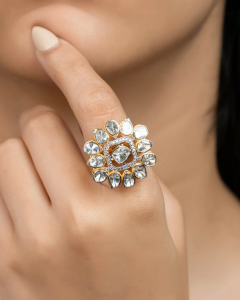
An engagement ring is where it all begins - that first “yes,” that trembling smile, that moment the heart commits to forever. Traditionally, it’s a symbol of intention - a promise to marry, beautifully captured in metal and stone. In India, engagement rings have evolved from being Western imports to emotional heirlooms. While diamond solitaires remain the classic choice, modern brides are embracing Tyaani’s Polki rings, emerald clusters, and unheated ruby solitaires - each crafted with old-world charm and new-age finesse.
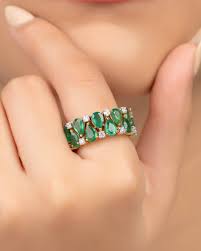
If the engagement ring celebrates the beginning of love, the wedding band honors its completion. Exchanged during the pheras or post-wedding ceremony, it represents unity, equality, and lifelong partnership. In Western traditions, bands are typically plain or subtly diamond-studded. But Indian couples are reimagining this simplicity - with Polki-encrusted bands, meenakari-detailed gold rings, or matching couple bands that harmonize beautifully with bridal jewellery.
India’s relationship with jewellery runs deeper than aesthetic appeal - every ornament is symbolic. Historically, marital symbols included the mangalsutra, chooda, bichhiya (toe rings), and sindoor. Rings, once rare in traditional customs, have now become a cherished part of the modern Indian wedding.
Today’s brides effortlessly blend these traditions - pairing their Polki engagement rings with elegant gold bands or diamond solitaires. For many, the ring exchange ceremony has become as emotionally resonant as the mangalsutra ritual.
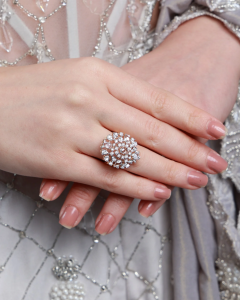
Though they may sparkle side by side, engagement rings and wedding bands tell different parts of the same story. An engagement ring is often bold and eye-catching - the centerpiece of the proposal. It symbolizes promise and individuality, usually featuring diamonds, Polki, or gemstones. A wedding band, in contrast, is understated and timeless - a daily wear symbol of commitment and equality.
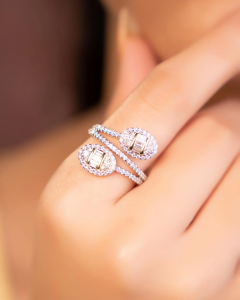
Traditionally and emotionally, the engagement ring comes first. It’s presented during the roka or sagai ceremony - the first official exchange of promises between two families. Months later, during the wedding, the wedding band joins in, completing the circle of love. However, Indian weddings are wonderfully diverse. In some regions, couples exchange both rings during the wedding itself, while others prefer engagement rings months in advance.
Whether you say “yes” under the stars or exchange vows amidst sacred fire, your jewellery should capture the essence of that moment - eternal, elegant, and deeply you. At Tyaani, we celebrate that moment through Polki rings that glow like heritage heirlooms and bands that whisper timeless grace. From handcrafted details to royal finishes, every piece carries India’s legacy of love and artistry.
An engagement ring is given during the proposal or engagement to symbolize the promise of marriage, while a wedding band is exchanged during the wedding ceremony as a symbol of unity and commitment.
The engagement ring always comes first - it marks the beginning of a couple’s journey together, signifying the proposal. The wedding band follows later, exchanged during the marriage rituals as a formal seal of that union. In most traditions, the engagement ring is worn before marriage, and the wedding band is added afterward.
Indian couples typically exchange rings during a pre-wedding ceremony known as the roka or sagai. This marks the official announcement of their engagement and symbolizes the families’ blessing of the union.
Yes, increasingly so. While the concept of wedding bands originated in the West, modern Indian couples - especially urban millennials - have embraced this tradition. Many prefer matching wedding bands as a contemporary expression of equality and lifelong companionship, blending Western elegance with Indian sentiment.
It’s a matter of personal choice. Some brides love stacking both rings as a stylish and symbolic gesture - the engagement ring representing the promise, and the wedding band signifying the fulfillment of that promise. Others prefer wearing just one for simplicity or cultural reasons.
Yes, most brides wear both on the same finger - the ring finger of the left hand - as it’s believed that a vein (the vena amoris) runs directly to the heart. In India, however, customs vary by region and religion, with some brides choosing to wear them on the right hand due to traditional beliefs.
Traditionally, no. The wedding band is meant to be exchanged during the wedding ceremony as part of the sacred vows. However, modern couples sometimes purchase their bands earlier and wear them symbolically during pre-wedding shoots or ceremonies - a sweet nod to their upcoming union.
There’s no fixed timeline - it depends on the wedding date. Typically, couples purchase their wedding bands a few weeks before the ceremony to ensure perfect fit, engraving, or custom design.
It’s not very common, but the trend is slowly growing. Traditionally, Indian grooms did not wear engagement rings, but modern couples are rewriting norms. Many grooms now wear a sleek band or a minimal design as a symbol of equality and mutual commitment - making the engagement moment meaningful for both partners.
In most Indian communities, engagement rings are worn on the right hand, as the left is considered less auspicious for certain rituals. However, with growing Western influence, many couples now prefer the left hand - especially those who also plan to wear a wedding band.
Not all. While Christian and Parsi weddings have traditionally included ring exchanges, Hindu, Sikh, and Muslim weddings have their own unique rituals - like mangal sutra, chooda, or nikah nama. However, modern interfaith and cosmopolitan weddings often blend these rituals beautifully, incorporating the exchange of rings as a universal symbol of love.
The practice gained popularity during the colonial era when British customs influenced Indian wedding traditions. Over time, the engagement ring evolved from a Western concept into a cherished Indian ritual.
Not necessarily. Some couples prefer perfectly matched sets for symmetry, while others enjoy mixing metals or contrasting designs for a personalized look.
Gold remains the most popular choice - a symbol of purity, prosperity, and divine blessings. However, modern couples are experimenting with white gold, platinum, and rose gold for a contemporary twist.
Indian grooms typically wear their wedding band on the right hand ring finger, aligning with cultural beliefs about auspiciousness. However, in urban or interfaith weddings, many follow the Western custom of wearing it on the left hand.
tyaanijewellery


