


Chat for Best Price
Unlock exclusive offers & much more
If you've ever admired the rich sparkle of traditional Indian jewellery and wondered whether it's Polki or Jadau — you're not alone. These two terms are often used interchangeably, but the truth is: they are not the same. While both represent the opulence of Indian craftsmanship, they serve very different roles in the jewellery-making process. Let’s unravel the mystery and understand what truly sets Polki and Jadau apart.
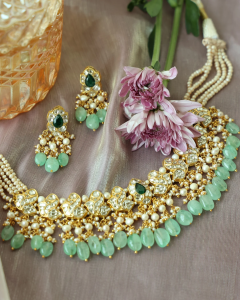
Polki refers to uncut, unpolished natural diamonds that retain their raw, organic form. These diamonds are typically flat with uneven surfaces, giving them a subtle, earthy shimmer that feels regal and antique. Polki jewellery is often backed with foil (called paachi) to reflect more light and enhance its natural brilliance. It's luxurious, heavy in gold content, and often features in bridal and heirloom collections.
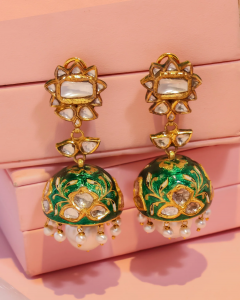
Contrary to popular belief, Jadau is not a type of stone — it’s a technique. Originating from the Mughal era, Jadau is a traditional method where stones like Polki, Kundan, pearls, and emeralds are embedded into gold without the use of solder. Instead, artisans use lac (a natural resin) and push the stones into hand-carved gold, securing them in place. Jadau pieces often feature intricate enamel (meenakari) work on the reverse, showcasing craftsmanship from both sides.
In the simplest terms:
Think of Polki as the star of the show and Jadau as the artful stage on which it shines. You can have Polki jewellery set in Jadau — and most traditional pieces do exactly that.
Both Polki and Jadau trace their roots to Mughal India, and their legacy has been preserved by master artisans in Rajasthan and Gujarat. Jadau flourished under royal patronage, especially in courts like Jaipur and Bikaner, where it became synonymous with bridal jewellery and ceremonial wear. Polki diamonds were prized for their rarity and raw charm, adorning everything from necklaces to sarpeches (turban ornaments) worn by kings.
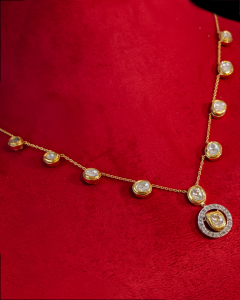
No — Jadau is a technique, not a stone.
Not quite. Kundan uses refined glass, while Polki uses natural uncut diamonds.
Mostly yes — but Polki can be set in other styles too, especially in modern or lightweight adaptations.
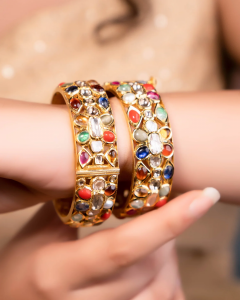
Polki Jewellery is ideal for:
Jadau Jewellery is ideal for:
Tip: You don’t have to choose one! Many modern brides wear Polki stones set in Jadau work, combining the best of both worlds.
Polki and Jadau aren’t rivals — they’re partners in creating timeless pieces of art. One is the raw beauty of the gem, and the other is the hands that turn it into something breathtaking. Whether you choose a glimmering Polki set or an intricately detailed Jadau piece, you're wearing a story steeped in legacy, culture, and soul.
Polki is the uncut diamond used in the jewellery, while Jadau is the technique used to set that stone into gold using lac and meenakari work.
No. Jadau is a handcrafted technique, not a gemstone.
Yes, but rarely. Most Polki jewellery is set using the Jadau method, though contemporary adaptations sometimes use prong or bezel settings.
Because Polki stones are irregular in shape and delicate, the Jadau technique is ideal for setting them securely while showcasing their natural beauty.
Polki jewellery is generally more expensive because it uses natural diamonds. Jadau adds labour cost but not as much material value unless paired with Polki.
Jadau itself doesn’t have significant resale value unless the stones used (like Polki) and gold content are substantial. It’s prized more for its artistry.
No. Polki is a stone; Jadau is a setting technique. They often go hand-in-hand but are fundamentally different.
Yes! Many Bollywood brides and global fashion icons wear Polki and Jadau, often as part of custom heritage bridal sets or festive couture looks.
Jadau’s value lies in its craftsmanship, not its resale worth. If it includes Polki diamonds and pure gold, then yes — it can hold significant value.
tyaanijewellery


