


Chat for Best Price
Unlock exclusive offers & much more
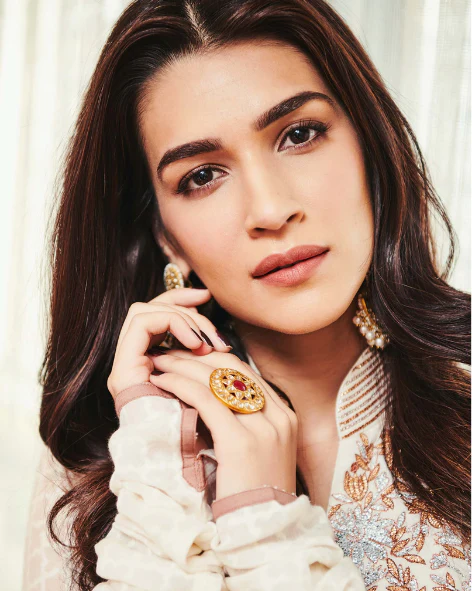
An engagement ring is more than a piece of jewellery - it is the circle of promise, the sparkling symbol of “forever.” Yet, every bride and groom in India eventually faces the same question: which finger should it go on? In movies and Western traditions, it’s almost always the left ring finger. But in Indian families, customs often differ, making the choice less straightforward. The answer lies in a fascinating blend of global influence, cultural heritage, and modern lifestyle - and at Tyaani, where tradition meets contemporary design, the engagement ring is crafted to shine no matter which hand wears it.
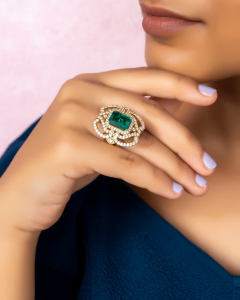
An engagement ring is more than a piece of jewellery - it is the circle of promise, the sparkling symbol of “forever.” Yet, every bride and groom in India eventually faces the same question: which finger should it go on? In movies and Western traditions, it’s almost always the left ring finger. But in Indian families, customs often differ, making the choice less straightforward. The answer lies in a fascinating blend of global influence, cultural heritage, and modern lifestyle - and at Tyaani, where tradition meets contemporary design, the engagement ring is crafted to shine no matter which hand wears it.
Across much of the world, engagement rings are worn on the left hand ring finger, believed to have the vena amoris or “vein of love” connecting directly to the heart. India, however, adds its own cultural layer. For centuries, the right hand has been considered more auspicious in Hindu and Jain traditions, leading many families to favor it. In practice, there’s no one “correct” hand in India - it often comes down to religion, region, and personal preference.
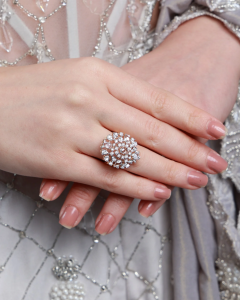
For brides, the engagement ring has become as essential as the lehenga itself. Traditionally, women wore rings on the right hand to honor cultural beliefs. Yet, with urban lifestyles and Western influence, the left-hand ring finger has become equally popular. Many brides now prefer the left because it pairs easily with wedding bands and feels globally recognizable. In styling, women often wear their engagement rings alongside bangles or kadas, and Tyaani’s polki and gemstone rings are designed to harmonize with bridal jewellery without losing their individuality.
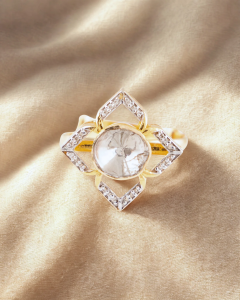
Unlike brides, Indian grooms historically did not wear engagement rings. The concept of men’s engagement bands is modern, inspired by Western trends and the rise of diamond and gold jewellery for men. Today, most grooms choose the left hand ring finger, though some families encourage the right for cultural reasons. Modern grooms are also experimenting with sleek platinum bands, engraved polki details, or gemstone accents, making engagement rings a shared symbol of commitment.
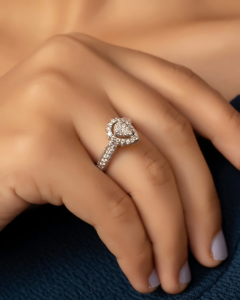
Engagement ring traditions are as diverse as India itself. In Hindu and Jain customs, the right hand often carries greater religious importance, though many younger couples lean toward the left. Christian families in India tend to follow Western traditions, wearing rings on the left hand. In Sikh weddings, either hand may be used depending on family tradition. Among Muslim couples, ring exchanges are not a historic practice but have been adopted in modern ceremonies, with the choice of hand varying. Regional differences also play a role - in some communities, couples even exchange rings for both hands, symbolizing balance and equality.
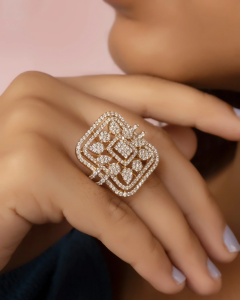
By 2025, the “left vs right” debate is becoming less important than style, comfort, and personal expression. Many brides stack their engagement ring with their wedding band, creating a layered look that works best on the left hand. Others wear a solitaire on the left and a polki statement ring on the right, blending modernity with heritage. Grooms increasingly prefer platinum or matte-finish bands, while brides are embracing gemstone-studded polki rings that complement bridal sets. The trend is clear: there is no rigid rule anymore. What matters is that the ring feels like yours.
In India, there is no single “official” engagement ring finger. The choice is shaped by tradition, faith, and modern preferences. What truly matters is the promise it represents and the story it tells. Whether you wear your engagement ring on the right or the left, on its own or stacked with a wedding band, Tyaani ensures that your ring becomes a timeless symbol of love - crafted with heritage artistry and modern elegance.
Traditionally, Hindu brides wear their engagement rings on the right hand ring finger, as the right hand is considered more auspicious in Hindu culture. However, many modern brides in urban India now prefer the left hand, influenced by Western customs and the practicality of pairing it with a wedding band.
Both are correct in India. In many communities, the right hand symbolizes purity and is preferred for cultural or religious reasons. At the same time, the left hand ring finger has grown popular due to Western influence and its symbolism of the “vein of love” leading to the heart. Couples often decide together which tradition feels more meaningful to them.
Yes, you can, though it is not the traditional choice. The middle finger can be used for comfort or astrological reasons, but the symbolism may be different. The ring finger is historically tied to love and commitment, while the middle finger is associated more with balance and individuality.
For most Indian women, the ring finger refers to the fourth finger of either hand. In traditional communities, the right hand is seen as auspicious, but with the spread of Western customs, the left hand has become equally common.
An engagement ring is given during the engagement ceremony as a promise of marriage. It is often more ornate, featuring solitaires, polki, or gemstones. A wedding ring, or band, is exchanged at the wedding itself and is usually simpler, symbolizing union and lifelong commitment.
India does not have a single official engagement ring finger. Practices vary by religion, region, and family. Hindu and Jain communities often choose the right hand for its auspiciousness, while Christians in India follow the left hand tradition. In cosmopolitan cities, couples increasingly adopt the left hand ring finger to align with global norms.
Indian grooms traditionally did not wear engagement rings, but this has changed with modern customs. Today, most grooms wear their bands on the left hand ring finger, though some families ask them to wear it on the right for cultural reasons.
No, engagement ring customs differ. Hindu and Jain families often prefer the right hand, Christians follow Western left-hand traditions, Sikhs vary by family, and Muslim couples have adopted the practice more recently, choosing based on personal preference. These variations highlight how diverse Indian engagement traditions are.
Yes, some couples do exchange rings for both hands, especially in progressive families where it symbolizes equality. Brides also sometimes wear a Western-style solitaire on the left and a traditional polki ring on the right, balancing modern trends with cultural heritage.
Polki rings are one of the most meaningful choices for Indian engagements. They bring centuries of heritage craftsmanship and pair beautifully with bridal attire like lehengas and sarees.
Yes. In North India, Western customs have had stronger influence, so the left hand ring finger is common. In South India, however, many families continue to prefer the right hand for its auspicious significance.
Yes, many couples choose gemstone rings like emeralds, rubies, or sapphires, either for their vibrant beauty or astrological significance. Gemstone rings are especially popular among brides who want a colorful alternative to diamonds.
Most Bollywood and cricket celebrities follow Western traditions and wear their rings on the left hand ring finger. Large solitaires are common, but many also opt for statement polki rings or colored gemstone rings, sparking new trends that brides across India quickly adopt.
Yes, solitaires remain a classic, timeless choice for Indian brides. They symbolize elegance and modernity, while polki and kundan designs reflect tradition. Many couples today prefer a fusion - solitaires with polki detailing - so their rings capture both worlds.
Stacking rings is a growing trend among Indian brides. It allows them to wear both the engagement ring (symbolizing the promise of marriage) and the wedding band (symbolizing union) on the same finger.