


Chat for Best Price
Unlock exclusive offers & much more
It’s a moment every couple experiences - standing together, holding a ring that means forever, and suddenly asking the unexpectedly confusing question: “Which hand does the marriage ring actually go on?”
Some say left, some say right, some say it depends on the religion, and some insist it’s entirely personal. With so many traditions, cultures, beliefs, and modern habits blending together, the wedding ring hand has become one of the most misunderstood parts of marriage symbolism.
Whether you’re newly engaged, planning your wedding, or simply curious, this guide will help you understand the meaning behind each tradition - and choose the hand that feels right for your love story. And as you explore Tyaani’s handcrafted jewellery, you’ll see that the sentiment behind a ring is far deeper than which hand it sits on.
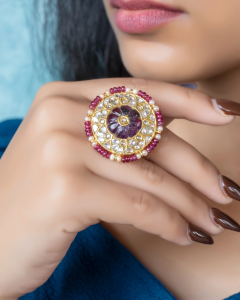
The confusion exists because wearing a marriage ring is not a universal cultural practice. For centuries, many societies never used rings during weddings. In others, rings were exchanged but worn on different hands. And in today’s global, interconnected world, traditions have mixed beautifully - but also created uncertainty. Western influence, Indian customs, religious differences, and modern preferences all play a role.
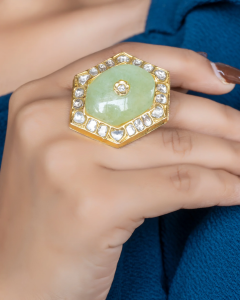
The left-hand tradition comes from ancient Rome, where people believed that the fourth finger of the left hand had a special vein - the vena amoris - that connected directly to the heart. Even though modern science does not support this, the symbolism of the “vein of love” became deeply rooted across Europe and later in the Western world.
Countries like the United States, Canada, the United Kingdom, France, Italy, Australia, and many others follow this tradition. For these cultures, wearing the ring on the left hand symbolizes intimacy, emotional closeness, and a direct connection to the heart.
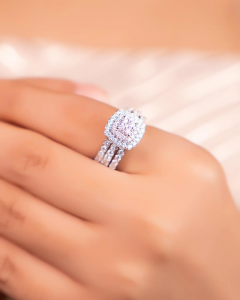
While the left-hand tradition is popular globally, several cultures proudly continue the right-hand ring practice. Countries such as Germany, Russia, Norway, Greece, Spain, and many in Eastern Europe wear wedding rings on the right hand.
For these communities, the right hand signifies strength, action, honour, and spiritual commitment. In many Christian Orthodox traditions, the right hand is considered pure and sacred - making it the natural choice for wedding rings. Right-hand rings also symbolize equality and independence in some modern interpretations. For some cultures, wearing the ring on the right hand is not just tradition - it is identity.
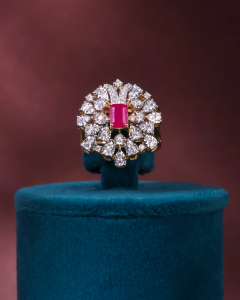
India is beautifully diverse, and so are its marital traditions. Historically, Hindu weddings did not use rings to signify marriage. Instead, symbols like the mangalsutra, sindoor, toe rings, or bangles represented commitment. Rings became popular with Western influence, Bollywood culture, and urban weddings.
Today, most Indian couples prefer:
It feels natural, familiar, and symbolic of love.
However, certain Indian communities - particularly Christian families, some South Indian traditions, and specific regional customs - may use the right hand.
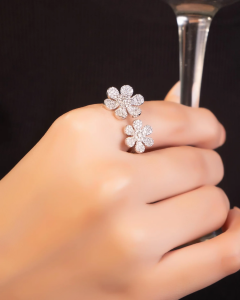
Traditionally, engagement rings and wedding rings are worn on the same hand - usually the left. In some cultures, women shift their engagement ring to the right hand during the wedding ceremony so the wedding band can be placed on the left ring finger. Afterward, they may stack both rings together. Other women prefer to separate the two, wearing the engagement ring on the right and the wedding ring on the left.
Traditions guide us, cultures shape us, but love belongs entirely to you. Whether your marriage ring rests on the left hand, the right hand, or even switches between the two - its true beauty lies in the bond it represents.
And when paired with Tyaani’s handcrafted jewellery, your ring becomes more than a symbol - it becomes part of your story, your heritage, and your personal style. Choose the hand that resonates with your heart, and let your jewellery express the depth of your commitment.
Traditionally, many cultures wear the marriage ring on the left hand, but several regions wear it on the right hand based on cultural and religious customs.
Most modern Indian couples wear wedding rings on the left hand, but certain communities may prefer the right.
No. Hindu weddings traditionally rely on symbols like mangalsutra and sindoor, not rings. Rings became popular later due to Western influence.
Most Indian men wear it on the left hand, though many choose the right for comfort or personal preference.
Indian women typically wear wedding and engagement rings on the left hand.
In most cultures, yes - both are worn on the left hand. But women may shift their engagement ring temporarily during the ceremony.
Yes, the left-hand tradition is common across these countries.
Yes. Orthodox Christianity, Judaism, Catholicism, and various regional beliefs influence whether the ring is worn on the right or left.
Islam doesn’t require rings, but many Muslim couples wear them on either hand based on cultural habits or personal choice.
Sikh ceremonies do not traditionally include rings, but many modern Sikh couples exchange rings and wear them on the left hand.
Yes. Modern couples freely choose the hand that feels right for them.
You can switch based on comfort, swelling, lifestyle, or personal meaning.
Traditionally yes, but it’s not mandatory. Many people wear engagement rings on a different hand after marriage.
tyaanijewellery


